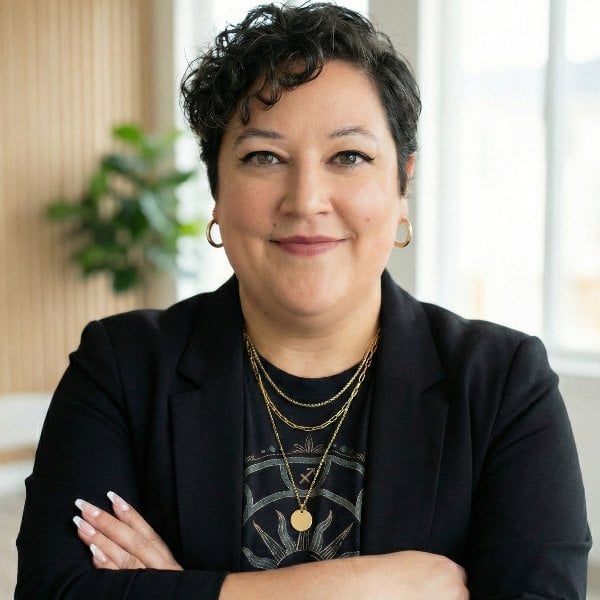
“Coach, tech founder, and AI builder who views the human experience through Human Design, astrology, and 15 years inside tech teams.”
I knew things before I had any business knowing them. I was about nine the first time I read my horoscope in the back of the newspaper, and I was immediately enamored with the way it felt to be known by someone unknown. Then I got lectured for an hour about the evils of astrology, and I learned the lesson underneath it: that part of me was not acceptable.
I graduated with a graphic design degree and quickly realized I needed to pay bills even if the job wasn't the one I wanted. I became the best salesperson in an optical shop. I loved the win and hated the work, and that was my first taste of burnout.
Eventually I went to graduate school in psychology, looking for a calling that would be acceptable. What I found instead was vocabulary. IFS, Jungian and depth psychology, trauma-informed practice: these didn't teach me how to do this work. They gave me words for what I'd been doing since I was a child. But I missed design. So I left with everything finished but the practicum, and I stopped trying to make myself legible to people who needed it to sound clinical.
Then I finally got the job I'd been aiming for all along. I spent fifteen years in technology, leading product and design teams at Genesys, CareMessage, and Sonatype, and I was good at it. I built systems and teams inside companies that quietly wore people down, and for a long time I thought the exhaustion was the price of doing serious work.
Along the way there were cycles of layoffs and stress. During one of them I bought my first tarot deck and a book about the chakras and the goddesses who embody them. I spent the pandemic going deep into myself and into psycho-spiritual work, and it wasn't instantaneous, but the light started to come on. Human nature, the metaphysical, architecture and design: they were all facets of the same existence.
Now I do all of it at once. I coach founders and executives. I read Human Design and astrology as structural instruments, not predictions. I'm co-founder and CPO of an AI women's health startup, and I build with models I think of as mirrors, the clearest collection of human energy we've ever assembled, reflecting what we are and revealing what we perform.
Which is the whole argument, really. Burnout isn't overwork. It's the cost of being someone you're not, inside organizations designed for a worker who doesn't exist. I know, because I did it for fifteen years.

Maia is a women's health platform offering whole-person care.